

Why Solving Today's Challenges Requires Us to Rethink How We Work Together
Over the past several years, I've had the privilege of sitting in rooms with people working on some of our country's most important challenges.
I've watched philanthropies and nonprofits wrestle with how to create lasting systems change. I've facilitated conversations between community leaders, government agencies, researchers, healthcare organizations, businesses, and residents, all bringing different experiences, expertise, and perspectives to the same table.
They do not enter those rooms because the work is easy. They come because the challenges in front of them are simply too complex for any one organization to solve alone.
Whether we're talking about improving healthcare, strengthening education, expanding economic opportunity, addressing housing, or creating more equitable communities, today's challenges are deeply interconnected. They require organizations across sectors, disciplines, and lived experiences to work together in ways that were once the exception but are now becoming the expectation.
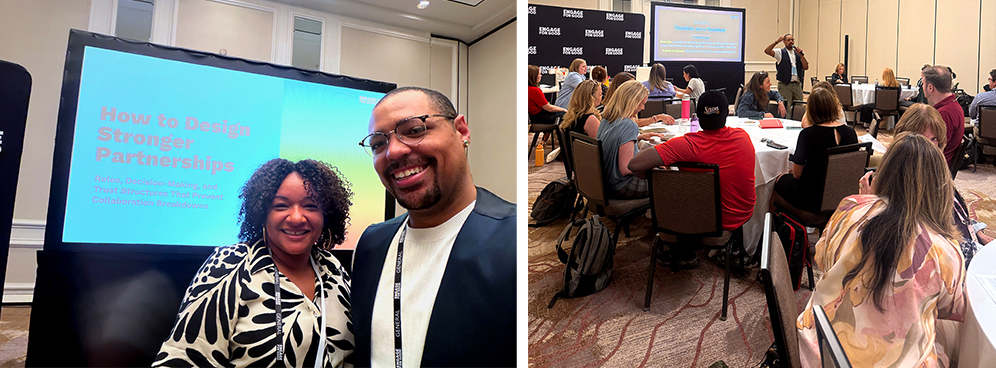
I recently had the opportunity to speak at Engage for Good’s 2026 Conference about what it takes to build stronger collaborations. A timely conversation, given the rapidly shifting philanthropic landscape. As public funding tightens, private and philanthropic capital are being asked to do more than fill funding gaps. They are being asked to catalyze solutions to increasingly complex societal challenges. In response, philanthropy has increasingly shifted from funding individual organizations to investing in collaborative ecosystems. Collaboratives, collective impact initiatives, co-governance structures, and cross-sector partnerships have become central strategies for systems change because they recognize a fundamental truth: no single organization has the expertise, relationships, or resources to solve today's challenges alone. Increasingly, impact depends not on organizations working in parallel, but on their ability to collaborate intentionally.
Collaboration has become one of the most important leadership capabilities of our time. Yet it's also one of the least taught. We spend years learning strategic planning, project management, budgeting, leadership, and communication, but very few of us are ever taught how to intentionally collaborate.
We aren't taught how to build trust across organizations with different histories. How to navigate disagreement without damaging relationships. How to recognize the impact of power and hierarchy on participation. How to create environments where people feel safe enough to contribute honestly. Or how to move a partnership from coordination to genuine shared ownership.
So we do what most of us have learned to do: we bring good people into the same room around a shared mission and assume collaboration will naturally happen.
Sometimes it does. Often, it doesn't.
In fact, research from Boston Consulting Group estimates that 60–70% of collaborations fail to achieve their intended outcomes. In my experience, that isn't because people lack commitment or good intentions. More often, it's because we've become exceptionally good at designing the work while giving far less attention to designing how people will work together.
We tend to assume that if the strategy is sound, the partnership will follow. But I've learned that the opposite is often true. Strong partnerships are what make strong strategies possible.
At We-Collab, we've learned that successful partnerships don't happen by accident. They are intentionally designed. Our approach helps organizations move beyond coordination and toward genuine collaboration by focusing on three essential practices. Many of the reflection questions we use with clients are included in our free Collaboration Playbook, which you can download to continue the conversation.
1. Design the Room Before You Design the Work
Most collaborations begin by defining goals, timelines, and deliverables. We begin by understanding the people.
Every participant brings relationships, lived experiences, assumptions, and power dynamics into the room. Those realities shape collaboration, whether we acknowledge them or not.
That's why we often start with stakeholder interviews, relationship mapping, and trust assessments before the work begins. Understanding the human landscape allows us to design environments where everyone can contribute more fully.
Practice: Before launching a collaborative effort, ask participants individually what excites them, what concerns them, and what they hope others understand about their perspective. Those conversations often surface opportunities and risks that never emerge in a group setting.
2. Make the Invisible Visible
The factors that most influence collaboration are often the ones least discussed: trust, power, communication, and competing definitions of success.
A 2024 PwC Trust Survey found that 93% of executives believe trust improves organizational performance, yet 94% report challenges building trust with stakeholders. Trust doesn't develop simply because people meet together. It grows through transparency, shared agreements, honest feedback, and meaningful opportunities to shape decisions.
The strongest partnerships move beyond informing and consulting stakeholders. They create shared ownership.
Practice: Don't assume trust exists because people have agreed to collaborate. Make time throughout the partnership to revisit expectations, surface concerns, and strengthen relationships.
3. Treat Tension as Data
Every collaboration experiences friction. Strong partnerships don't avoid it- they learn from it.
Rather than asking, "How do we eliminate this tension?" ask, "What is this tension trying to teach us?" More often than not, tension reveals communication gaps, unclear expectations, unresolved power dynamics, or differing definitions of success.
When organizations treat tension as insight instead of failure, they become more adaptive, resilient, and better equipped to navigate complexity together.
Practice: Build regular reflection points throughout your collaboration. Small adjustments made early often prevent much larger challenges later.
Collaboration Is Human Work
The challenges defining this decade won't be solved by organizations working in isolation. They'll be solved by organizations capable of building extraordinary partnerships.
That requires leaders who value relationships as much as strategy, curiosity as much as expertise, and trust as much as execution.
At We-Collab, we've found that collaboration is the human infrastructure that makes lasting impact possible. And like any capability, it can be intentionally designed, strengthened, and practiced over time.
For organizations looking to deepen this work, We-Collab has developed a Collaboration Playbook that offers practical tools, frameworks, and strategies for building stronger partnerships and navigating complexity together.