


We-Collab attended and presented at the Independent Sector National Summit 2025, where leaders from across the charitable ecosystem—nonprofits, foundations, and corporate giving programs—came together to build capacity, share knowledge, foster collaboration, and strengthen advocacy.
This year’s summit underscored a truth we see across our work: the charitable sector is at a critical inflection point. Organizations are operating under new legal, cultural, and political pressures while also holding real power to shape systems. By uniting voices and aligning strategies, the sector is beginning to unlock its collective potential: to meet the moment and move progress forward.
Three interconnected themes echoed throughout the summit and in our own conversations:
- Legal risk is reshaping operating norms.
- A new framework for sector infrastructure is taking shape.
- Local responsiveness is emerging as the strongest driver of trust and impact.
Our session reflected those same dynamics, centering on how teams build readiness, collaboration, and trust when the ground is shifting beneath them.
Legal Risk: From Anxiety to Action
Legal exposure has become a strategic reality. Congressional inquiries, lawsuits, and media scrutiny are converging, pushing organizations to strengthen documentation and decision trails. The most prepared teams are treating readiness as empowerment: setting 90-day email retention baselines, clarifying inquiry protocols, and practicing board response steps before a crisis hits.
At We-Collab, we see legal readiness as more than compliance—it’s a platform for courage. Readiness should create space for boldness, not limit it. In our session, one corporate foundation leader shared that their team was told they couldn’t feature Black men in a critical men’s health campaign (while problematic as it is, not uncommon in this landscape). We suggested reframing the narrative by considering what other intersecting identifiers could show up in the campaign along with Black men's narratives, such as those of veterans, community leaders, etc. The goal is not to give in to exclusion, but rather to find ways in this environment to push forward. The takeaway: legal clarity and creative framing can open new paths forward.
Sector Coordination: Building an Infrastructure for a Just Future
According to the Trust in Nonprofits and Philanthropy report, Americans support nonprofits, with 57% of Americans say they have “high-trust” in nonprofits—the only institution to receive a majority of Americans’ support. A stark contrast to the distrust that is growing in other institutions, such as corporations, news media, and the federal government.
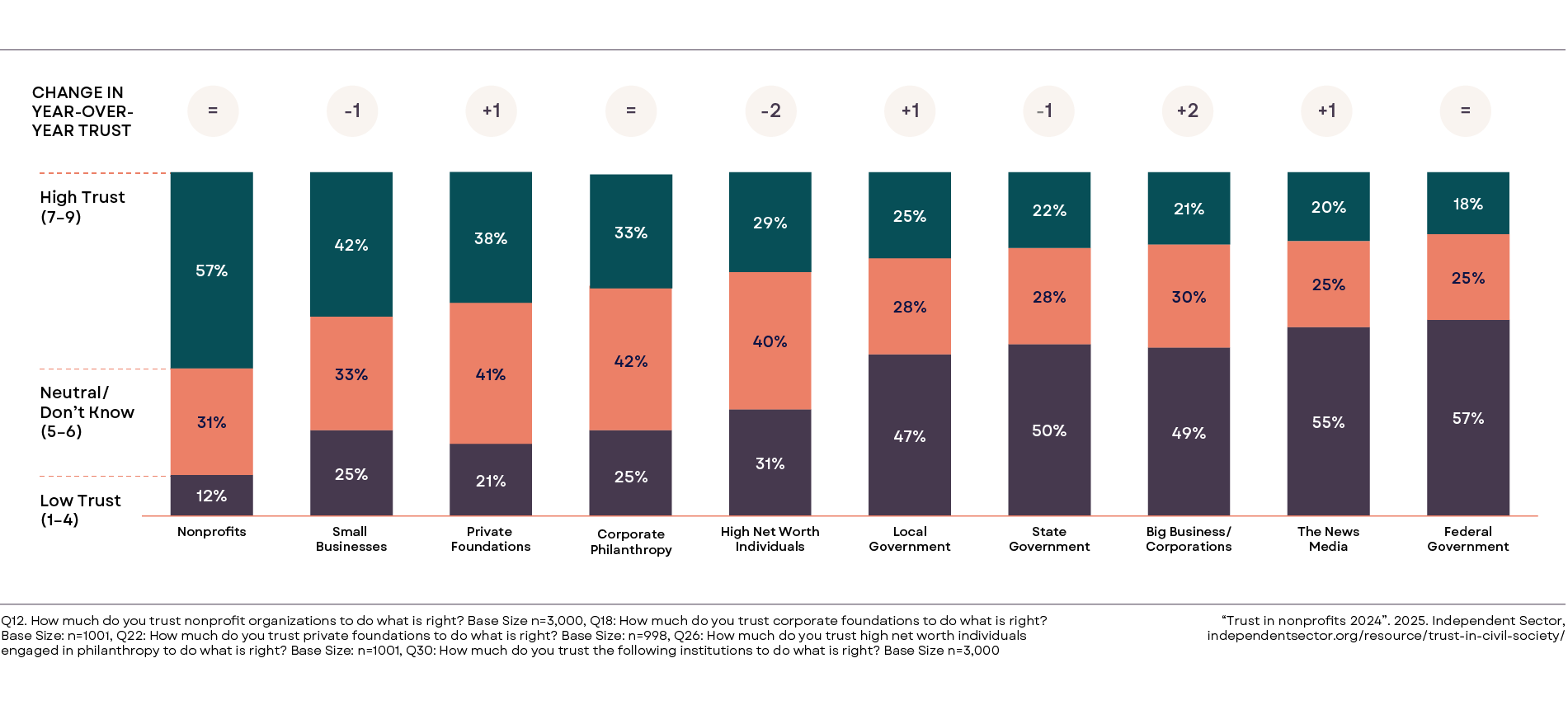
To amplify that trust, Independent Sector and peer organizations are aligning their roles in litigation, policy, and advocacy after years of fragmented effort. As part of that work, Independent Sector has launched the Nonprofit Coalition Connection, a tool designed for coalition building and advocacy engagement.
We-Collab saw that same appetite for alignment firsthand. In our session, participants asked how to strengthen internal trust as the foundation for external coordination. One staff member from a health foundation described a “low-trust team just trying to find where to start.” Our shared reflection: readiness begins with trust, and trust begins with clarity.
We’re seeing this same momentum across our partnerships. Organizations are eager to turn shared goals into synchronized action through coalition governance, scenario planning, and transparent decision-making.
Local over national: responsiveness builds trust
Across the sector, proximity to community needs is emerging as the differentiator. Funders are segmenting roles by risk tolerance. Some are taking visible legal stands, while others are providing quiet, coordinated support. Local bridge-building is proving pragmatic: partnerships among the YMCA, Habitat for Humanity, Catholic Charities, and Interfaith Ministries are training volunteers to connect across lines of difference.
“Responsiveness builds relevance. Relevance builds trust.”
— Suzanne McCormick, CEO, YMCA USA
When organizations listen closely and adapt quickly, trust grows. The most resonant insight from the summit was that relevance is built locally, even as strategy scales nationally.
What this means going forward
The signals are clear. Nonprofits and funders are being called to:
- Anchor in values, act with strategy. Name values, define risk tolerance, and replace fear-based postures with scenario-based playbooks.
- Invest in coalition capacity. Map shared outcomes, formalize MOUs, and prepare for faster collective action.
- Operationalize legal readiness. Align retention, approvals, and escalation steps—and rehearse them.
- Go hyper-local to earn trust. Build short feedback loops, co-create with local partners, and scale what works.
What We’re Taking Forward
This year’s summit reinforced what drives our work at We-Collab: readiness, coordination, and courage are collective practices. The sector is moving toward greater alignment and shared infrastructure, and that work depends on trust—within teams, across coalitions, and with the communities we serve. This moment demands more than resilience. It asks for readiness—built together, with purpose.
Our Invitation
If these themes resonate with your organization, start small:
- Look for places where legal clarity can unlock bold moves. How might your team use counsel to advance impact rather than slow it down?
- Map where alignment is strong and where coordination breaks down.
- Ask how your programs stay close to community voice when decisions scale nationally.
And if you’d like to explore these questions with peers, We-Collab is here. We’re glad to share tools, practices, and stories from partners about what’s working on the ground.
You can find more about the tools we shared at Independent Sector on our ISNS 2025 resource page.